
INTRO
Fleet and mobility platforms are scaling faster than ever—expanding across cities, adding depots, increasing vehicle turnover, and serving a growing mix of drivers and customers. As operations grow, one process quietly becomes a constraint on uptime and customer experience: handover inspections.
Many fleets still depend on manual walkarounds, photos, dashboard warning lights, and driver-reported issues to decide whether a vehicle is ready to release. This approach can work at small scale, but it becomes increasingly fragile as volumes rise. Vehicles sit idle while teams re-check ambiguous issues, disputes consume operational time, and leaders across operations and finance lack consistent data to determine what needs to be repaired—and when.
A practical way to modernize this workflow is to make each inspection evidence-backed—without deploying expensive wired telematics boxes across the fleet. By integrating app-based OBD-II data capture into the platform’s existing mobile app, each handover check becomes a standardized event that teams in Ops, Product, and Engineering can audit, compare, and automate against.
CHALLENGE
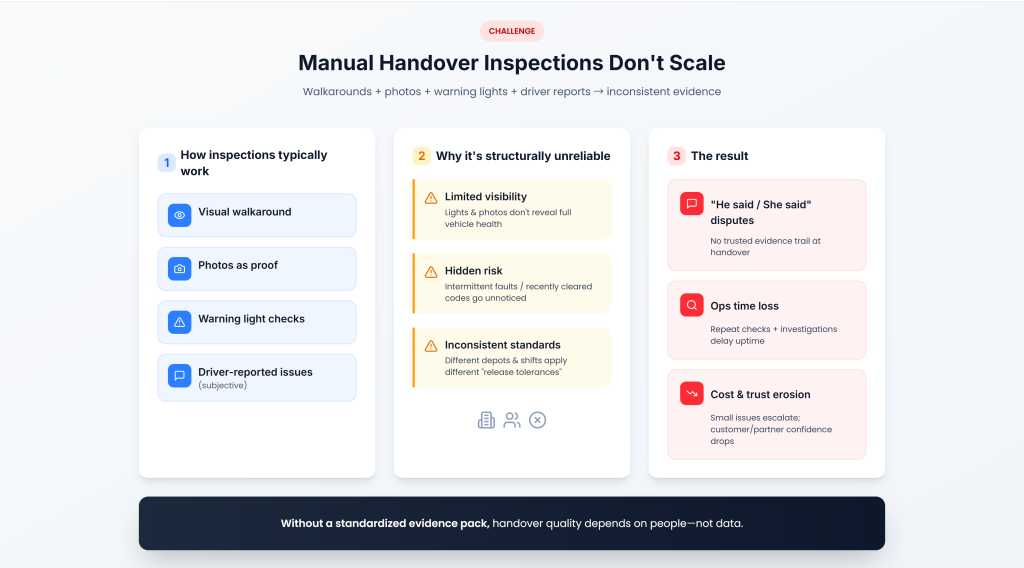
How inspections typically work
Most fleet and mobility platforms still rely on a mix of visual walkarounds and photos, warning light checks, driver-reported issues via app (subjective and inconsistent), and extra checks after a complaint arises. This can work for small, local operations, but it becomes fragile in large-scale, always-on fleets with multiple depots across cities.
Why this approach is structurally unreliable
Even with good staff and clear SOPs, traditional inspections have inherent limitations. Visual checks and warning lights can’t provide the full picture of vehicle health. Intermittent faults or recently cleared diagnostic codes can remain undetected until they become failures. And different depots and shifts often apply different “release tolerances,” creating inconsistent quality across the fleet.
The result: “he said / she said”
When a vehicle fails or a customer complains, there is often no trusted evidence trail showing the vehicle’s condition at handover. Ops spends time investigating disputes, finance sees small issues escalate into larger repair costs, and customer/partner trust erodes due to inconsistent outcomes.
SOLUTION
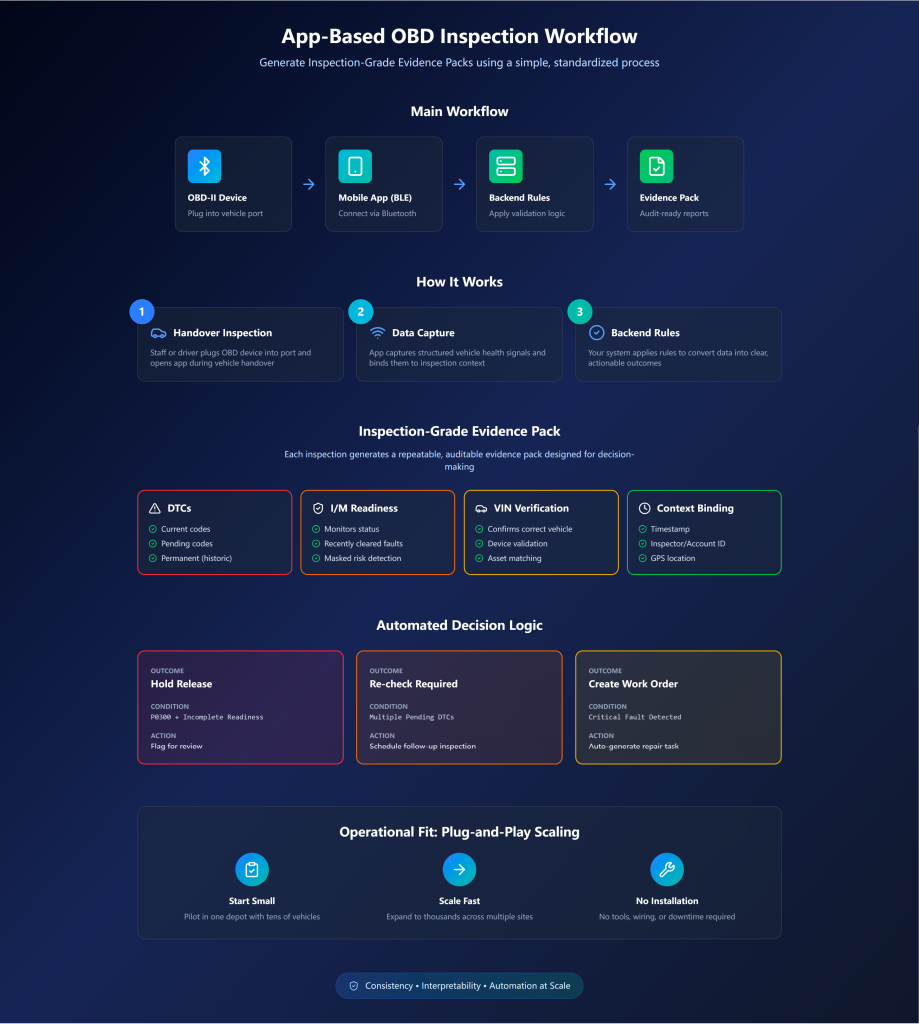
App-based OBD inspections that create audit-ready evidence packs
Drove West enables fleet and mobility platforms to generate Inspection-Grade Evidence Packs using a simple workflow:
OBD-II data → Your mobile app (BLE) → Your backend rules → Clear events & reports
You don’t need to roll out expensive wired telematics boxes to solve the inspection problem. A phone-paired Bluetooth OBD device combined with your existing app is enough to standardize the process. Staff or drivers plug it into the OBD-II port, connect via standard BLE on iOS/Android, run an in-app check, then remove it after the inspection (or leave it in for repeated checks—depending on your workflow).
How it works
During a handover inspection, the app captures a structured set of vehicle health signals and binds them to inspection context. Your backend applies rules to convert this into clear, explainable outcomes (e.g., “hold release”, “re-check required”, “create work order”). When a dispute happens later, teams reference a consistent, timestamped inspection record rather than subjective descriptions.
The Core Differentiator: Inspection-Grade Evidence Pack
Each inspection generates a repeatable, auditable evidence pack designed for decision-making, including:
- DTCs: current, pending, and permanent (historic) trouble codes
- I/M readiness: identifies vehicles with recently cleared faults (masked risk)
- VIN verification: confirms the device is connected to the correct vehicle
- Context binding: timestamp, inspector/account ID, and GPS location(from cellphone ) tied to the report
Why this is credible for your tech team
Platforms need consistency and interpretability—not just data access. Evidence packs use structured, typed fields that are easier to validate and normalize across vehicle models. Rules can be applied in a clear way—for example: “If Code P0300 + readiness incomplete = flag for review”, removing subjective judgment and enabling automation at scale.
Operational fit
Because the workflow is plug-and-play with no tools or wiring, platforms can start small and expand quickly. Teams can pilot in one depot with tens of vehicles, then scale to thousands across multiple sites without installation downtime.
TOPOLOGY
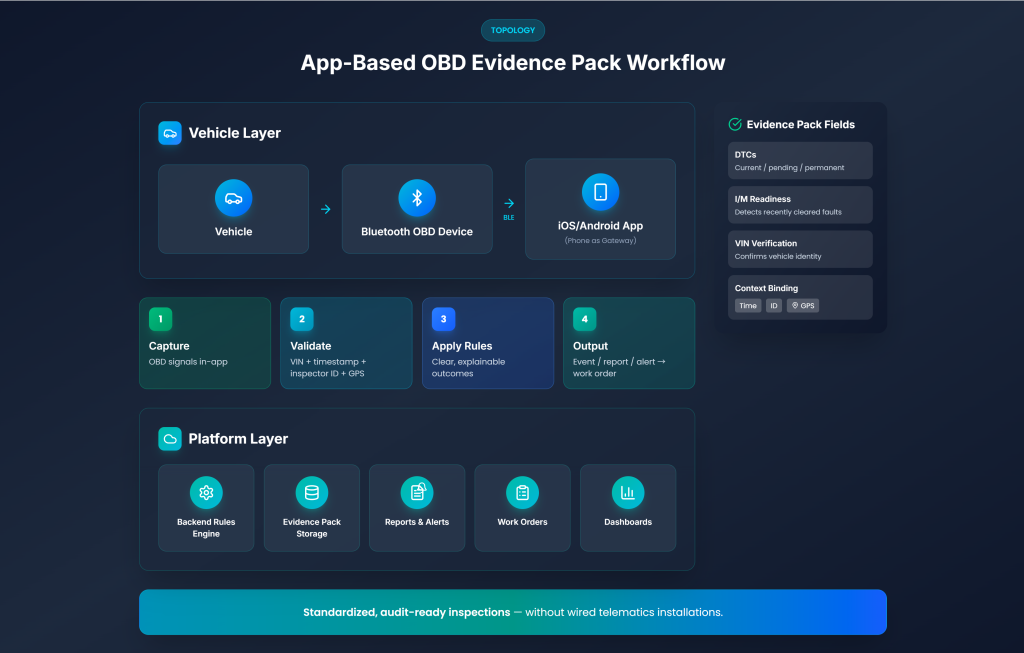
- Vehicle: Bluetooth OBD device → (BLE) → iOS/Android app (phone as gateway)
- Platform: app → backend rules engine & storage → reports/alerts → work orders & dashboards
- Flow: capture → validate (VIN + context) → apply rules → output event/report
BENEFITS
Accurate, evidence-backed inspections
The evidence pack creates a shared source of truth at handover and reduces “he said / she said” disputes.
Improved operational efficiency
Standardized checks reduce repeat inspections, speed up vehicle turnaround, and keep the fleet ready for the next trip.
Optimized business costs
Earlier detection prevents small issues escalating into major repairs and helps identify suspicious patterns (e.g., repeated clears or recurring faults).
Improved customer experience
Consistent vehicle quality and faster dispute resolution increase customer and partner trust.
Scalable fleet operations
Start in one depot next week with zero wiring—then scale from tens of vehicles to thousands across multiple sites.
WHY DROVE WEST?
Drove West focuses on OEM/private-label Bluetooth OBD hardware for B2B platforms—not consumer gadgets.
Integration-first delivery: documentation, samples, and testing paths engineering teams need to validate quickly
Production mindset: help define stable specs (power modes, protocols) for fleet scale
Supply continuity: batch management to avoid disruptive “silent hardware changes”

BANNER.png "car tpms 3 安装渠道(轮胎店 维修连锁 改装店)banner - Drove West OBDII Scanner")

BANNER.png "car tpms 1 aftermarket 零售品牌 dtc 电商品牌(卖给车主)banner - Drove West OBDII Scanner")
 English