
INTRO
Install shops live on a simple equation: limited bays → maximum hourly output.
TPMS should be one of the best “safety upgrade” add-ons—but it often turns into a comeback trap:
customer returns next day saying “it’s beeping,” “numbers jump,” “not accurate,” or “it disconnected.”
When that happens, you don’t just lose a sale—you lose bay time, staff attention, and your review score.
A high-ROI TPMS upsell needs three things:
- Easy to sell (a staff script that works in 10 seconds)
- Easy to validate at handover (no guessing, no “hope it’s fine”)
- Low comeback risk (clear expectations + predictable delivery)
That’s exactly why the lineup is structured as V102A (internal, main install) + V11B (external, quick-sell).
CHALLENGE
-1-scaled-e1769853663967-1024x828.png "car tpms 3 安装渠道(轮胎店 维修连锁 改装店) 1 - Drove West OBDII Scanner")
What typically happens
- A customer asks “Can you add TPMS?” and the shop recommends whatever is available.
- Handover is based on “looks okay” instead of a standard acceptance step.
- When a customer sees alerts or data variation later, they come back to the shop—often frustrated.
Root causes (not a “shop skill” issue)
TPMS confusion is structural:
- Cold vs hot pressure and temperature changes naturally move readings—customers interpret this as “wrong.”
- External vs internal vs OE TPMS gets mixed together in the customer’s head—expectations drift fast.
- If validation and explanation aren’t part of the handover, the shop is forced into reactive support.
The operational cost
- Workshop/Service Manager: comebacks occupy bays → lower bay utilization and slower queue.
- Owner/Store Manager: labor profit gets eaten → staff stop pushing TPMS, AOV stalls.
- Chain Quality/Aftersales: more tickets and complaints → pressure on store ratings and consistency.
Hidden loss
Once TPMS is labeled “a hassle,” the shop quietly stops recommending it—losing a repeatable upsell category. In peak season, every comeback costs even more.
SOLUTION
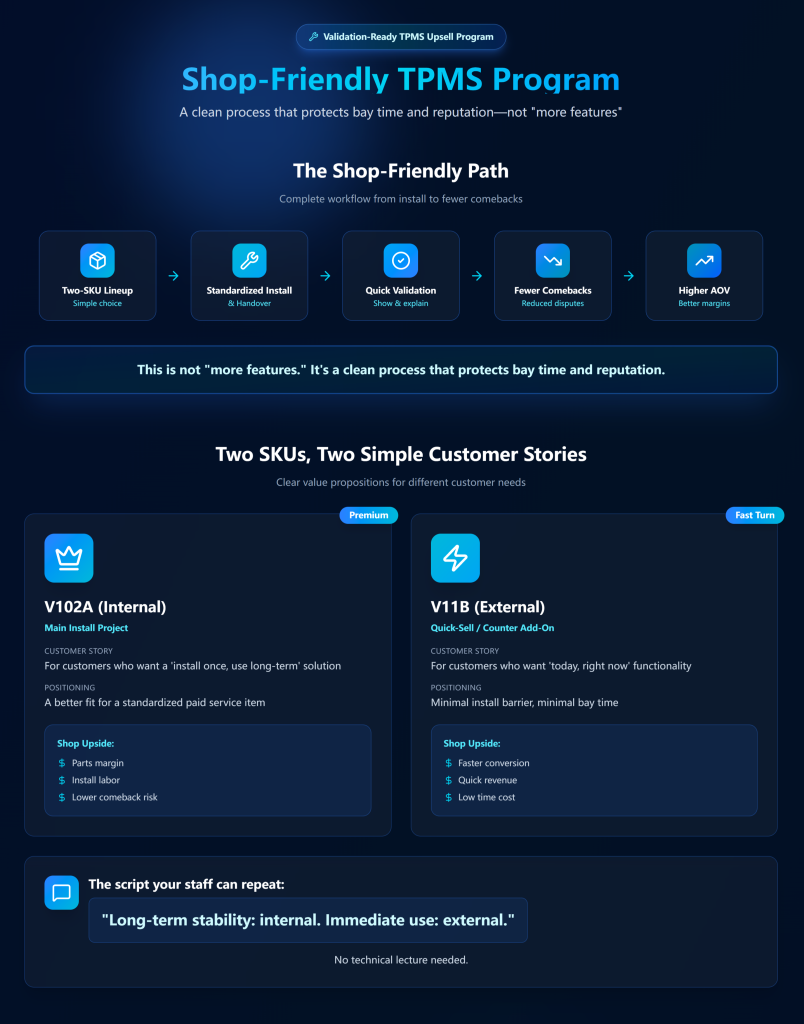
A validation-ready TPMS upsell program
The shop-friendly path
Two-SKU lineup → standardized install & handover → quick validation → fewer comebacks → higher AOV
This is not “more features.” It’s a clean process that protects bay time and reputation.
Two SKUs, two simple customer stories
V102A (Internal) — Main install project
- For customers who want a “install once, use long-term” solution
- A better fit for a standardized paid service item
- Shop upside: parts margin + install labor + lower comeback risk
V11B (External) — Quick-sell / counter add-on
- For customers who want “today, right now” functionality
- Minimal install barrier, minimal bay time
- Shop upside: faster conversion + quick revenue + low time cost
The script your staff can repeat:
“Long-term stability: internal. Immediate use: external.”
No technical lecture needed.
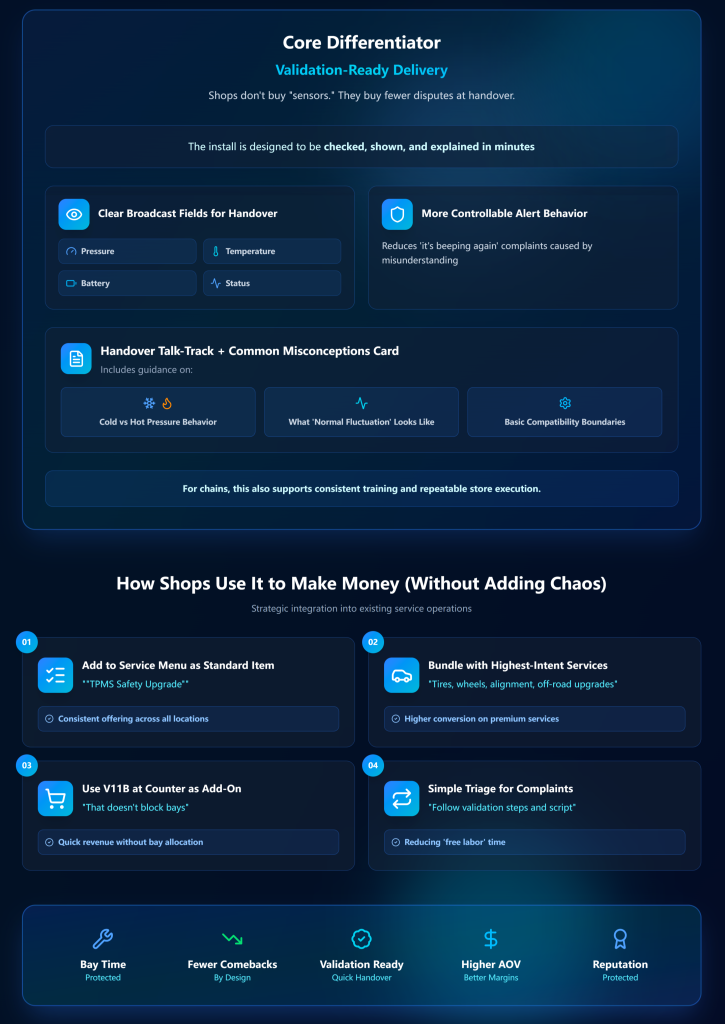
Core differentiator: Validation-Ready Delivery
Shops don’t buy “sensors.” They buy fewer disputes at handover.
Validation-Ready Delivery means the install is designed to be checked, shown, and explained in minutes:
- Clear broadcast fields for handover: pressure / temperature / battery / status
- More controllable alert behavior (reduces “it’s beeping again” complaints caused by misunderstanding)
- A handover talk-track + common misconceptions card
- cold vs hot pressure behavior
- what “normal fluctuation” looks like
- basic compatibility boundaries
For chains, this also supports consistent training and repeatable store execution.
How shops use it to make money (without adding chaos)
- Add it to the service menu as a standard item: “TPMS Safety Upgrade”
- Bundle with your highest-intent services: tires, wheels, alignment, off-road upgrades
- Use V11B at the counter as an add-on that doesn’t block bays
When complaints happen, the shop can follow a simple triage using the validation steps and script—reducing “free labor” time
TOPOLOGY
-2-scaled-e1769854218930-1024x823.png "car tpms 3 安装渠道(轮胎店 维修连锁 改装店) 2 - Drove West OBDII Scanner")
Simple, non-scary, shop-first
- Vehicle: V102A (internal) or V11B (external) sensors
- Communication: BLE broadcast
- Validation: a shop-side verification app/tool can be used for handover acceptance
- Delivery assets: quick guide, misconceptions card, FAQ
Important: the app is a verification tool, not a business dependency. Your selling motion should not rely on “customers must install an app to make it work.”
Benefits (mapped to shop and chain KPIs)
- Higher AOV: internal as a paid install project + external as add-on conversion
- Fewer comebacks: validation + clear expectations reduce misunderstandings
- Better bay utilization: less rework during peak queues
- Lower complexity: two SKUs cover “quick sell + long-term install”
- Easier chain rollout: unified materials, consistent training, stable SKU lifecycle
(You can measure improvement via comeback rate, ticket volume, and handover time per job during a pilot.)
WHY DROVE WEST?
Shop-friendly SKU strategy: V102A for install profit, V11B for fast conversion
Delivery pack included: handover validation flow + talk-track + FAQ (built to reduce explanation time)
Version stability & supply continuity: supports long-term service menus and peak replenishment planning
OEM/white-label options: packaging, language, and store program materials for chains


BANNER.png "car tpms 1 aftermarket 零售品牌 dtc 电商品牌(卖给车主)banner - Drove West OBDII Scanner")

 English