
INTRO
Automotive apps often hit a growth ceiling not because of missing features, but because the data entry point is uncontrolled. When your experience depends on whatever dongle a user bought—and whether it pairs, stays connected, and reads consistently—conversion drops, retention suffers, and support costs rise. To scale a repeatable product line without building a hardware organization, the hardware layer must become a controllable variable.
CHALLENGE
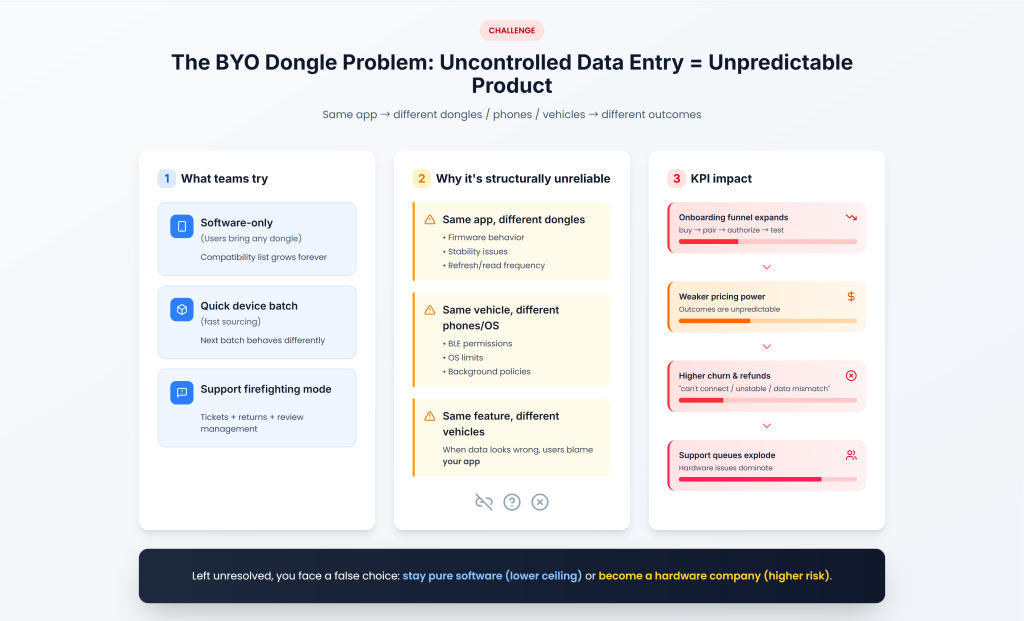
Most teams start software-only: users bring their own dongle and the compatibility list grows forever. Others source a quick device batch, only to see the next batch behave differently—pairing issues, unstable sessions, inconsistent refresh rates, and sudden ticket spikes. Meanwhile, teams get pulled into adaptation work, returns, and review management—turning a software team into a hardware support team.
This is structurally unreliable:
• Same app, different dongles → different firmware behavior, stability, and refresh/read frequency.
• Same vehicle, different phones/OS → BLE permissions, OS limits, and background policies change the experience.
• Same feature, different vehicles → users don’t blame the car when data looks wrong; they blame your app.
The KPI impact is direct: longer onboarding funnels (buy → pair → authorize → test), weaker subscription pricing power due to unpredictable outcomes, higher churn/refunds, and support queues dominated by “can’t connect / unstable / data mismatch.” Left unresolved, you face a false choice: stay pure software with a lower ceiling, or become a hardware company with supply-chain risk. The practical third path is software-first: keep your app as the product, while making the hardware layer a controllable growth lever.
SOLUTION
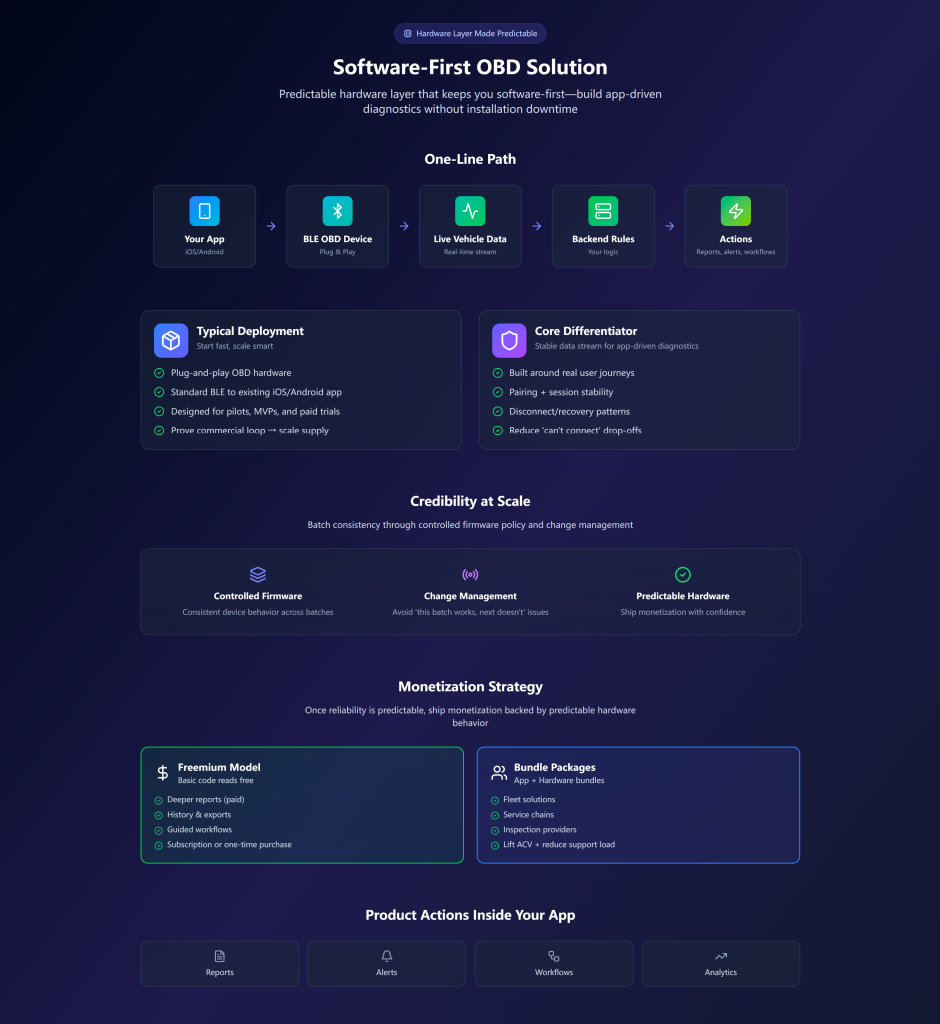
Drove West makes the hardware layer predictable—while keeping you software-first.
One-line path: Your App → connects to our Bluetooth OBD device → reads live vehicle data → your backend rules → actions inside your product (reports, alerts, workflows).
Typical deployment: plug-and-play OBD hardware + standard BLE to your existing iOS/Android app. It’s designed for pilots, MVPs, and paid trials first—prove the commercial loop, then scale supply without installation downtime.
Core differentiator: Stable data stream for app-driven diagnostics. Device behavior is built around real user journeys (pairing, session stability, disconnect/recovery, and predictable read patterns) to reduce “can’t connect” drop-offs and “data is wrong” complaints.
Credibility at scale comes from batch consistency: controlled firmware policy and change management to avoid “this batch works, the next batch doesn’t.”
Once reliability is predictable, you can ship monetization with confidence. Many apps keep basic code reads free, then monetize deeper reports, history, exports, and guided workflows as subscription or one-time purchases—now backed by predictable hardware behavior. You can also bundle “App + Hardware” packages for fleets, service chains, or inspection providers to lift ACV, while reducing support load as tickets drop.
TOPOLOGY
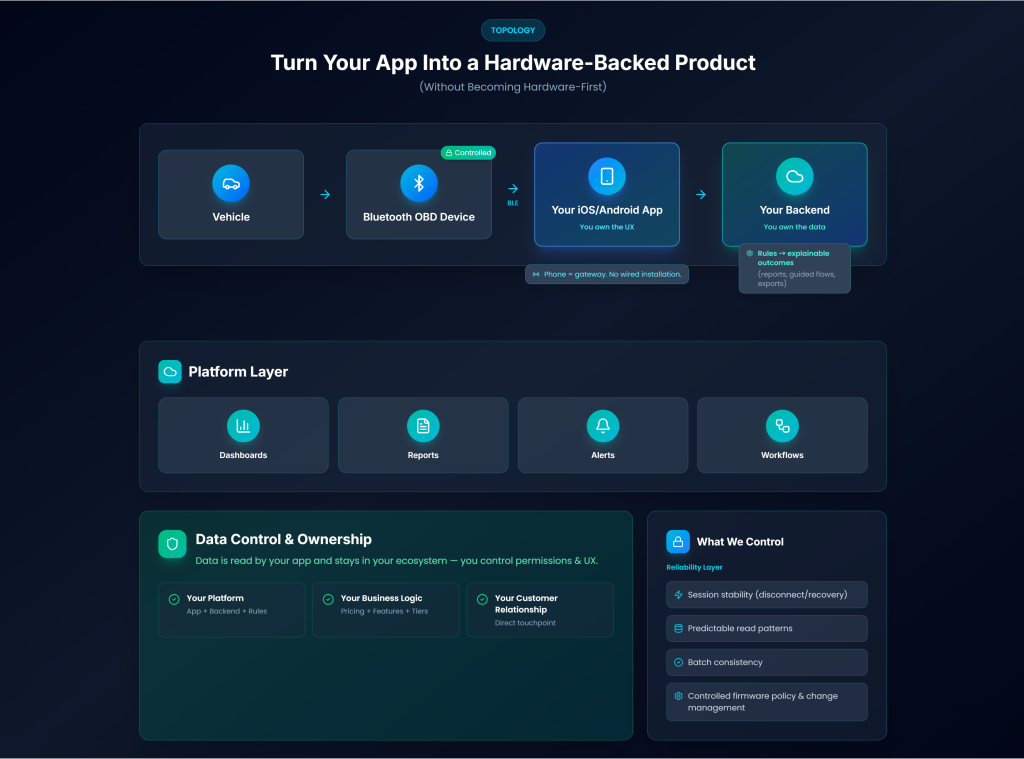
Vehicle → Bluetooth OBD Device → BLE → Your iOS/Android App → Your Backend → Dashboards / Reports / Alerts / WorkflowsData is read by your app and stays in your ecosystem—you control permissions and UX.
BENEFITS
• Higher ARPU: price “hardware-backed” tiers with reliable outcomes.
• Better conversion: remove dongle uncertainty—users know “this will work” during onboarding.
• Lower churn: fewer connection failures and inconsistent-data complaints.
• Lower support cost: fewer tickets about pairing, instability, and inconsistent behavior.
• Faster go-to-market: pilot quickly, prove revenue, then scale supply.
Typical impact shows up quickly in smoother onboarding and fewer support tickets—measurable in weeks, depending on your workflow.
WHY DROVE WEST?
Software-first partnership: we focus on OEM-ready supply so you stay product-led.
Delivery you can plan around: clear MOQ/lead time visibility with a batch-consistency mindset.
Integration-ready support: documentation and evaluation samples for technical validation.
Built for B2B growth: OEM / ODM branding options and scalable manufacturing for channel expansion.
For scale, we support serial-number tracking, batch consistency, and QC processes—plus OEM/ODM branding for shells, labels, and packaging.

BANNER.png "car tpms 3 安装渠道(轮胎店 维修连锁 改装店)banner - Drove West OBDII Scanner")

BANNER.png "car tpms 1 aftermarket 零售品牌 dtc 电商品牌(卖给车主)banner - Drove West OBDII Scanner")
 English