
INTRO
On Amazon, eBay, and DTC sites, OBD demand is steady. But for a brand, success isn’t defined by whether a dongle can sell—it’s defined by whether it can keep selling. Ratings and return rates directly determine ad ROI, ranking, and repeat purchase. At the same time, scale depends on factors most white-label products ignore: batch consistency, compliance readiness, stable supply, and support that doesn’t spiral.
Many “high-volume” generic OBD devices look strong on paper, but they leave the real costs to the brand: mis-buys, pairing failures, unclear expectations, and version drift that triggers review spikes. A private-label OBD product should do the opposite—turn the SKU into predictable cash flow, not a support and returns sink.
CHALLENGE
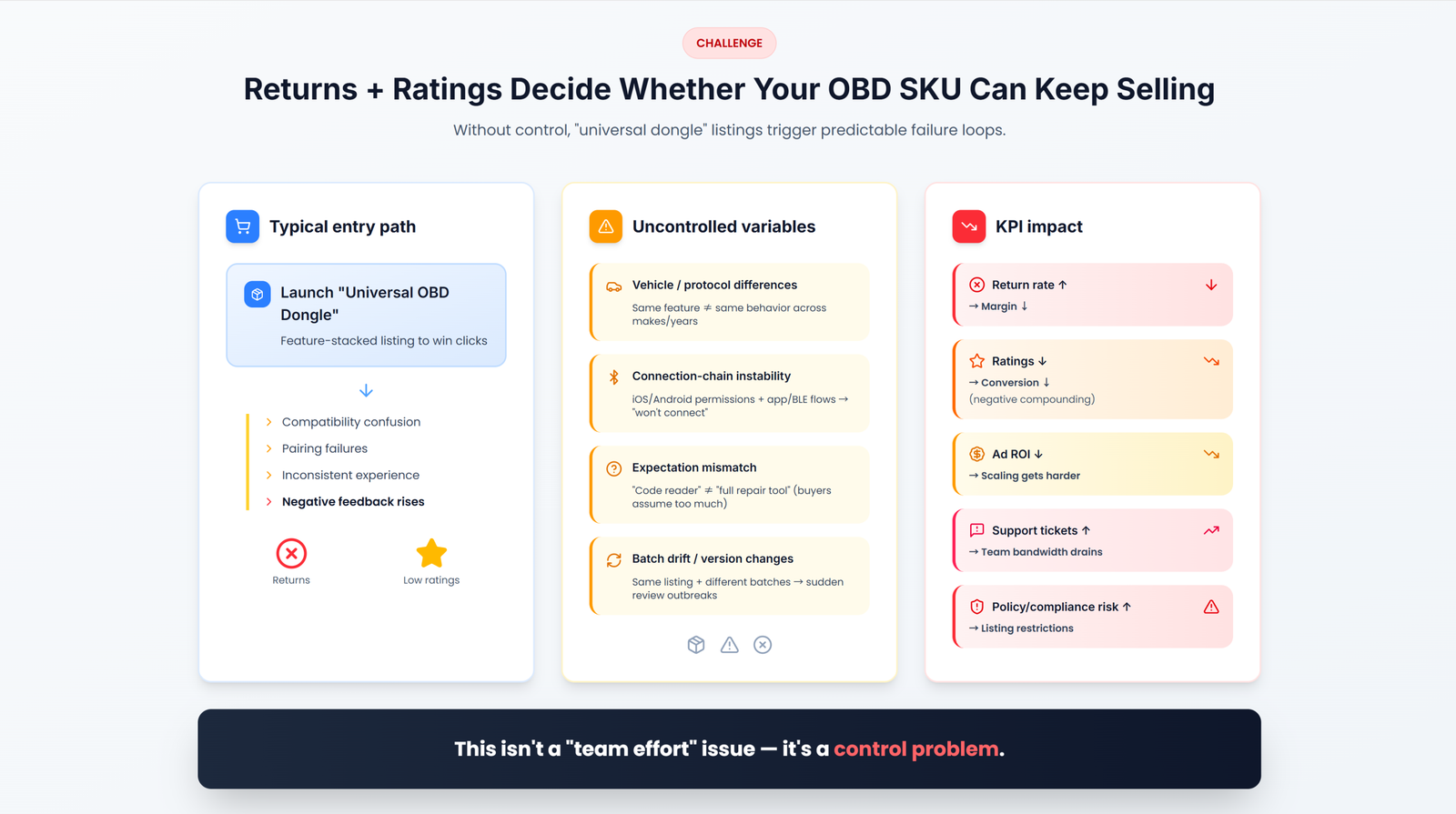
How brands typically enter the category
Most brands follow a familiar path:
They launch a “universal OBD dongle” to test volume, stack feature claims on the listing to win clicks, then encounter the same outcome—connection issues, compatibility misunderstandings, inconsistent user experience, and rising negative feedback. Over time, the loop becomes painful: ads get more expensive, conversion drops, return rates climb, and cash flow tightens.
Why this becomes unavoidable without control
This is not a team-effort problem. OBD products carry inherent variables that must be managed:
• Vehicle and protocol differences: the same “feature” behaves differently across makes/years.
• Connection-chain instability: iOS/Android Bluetooth flows, permissions, and app differences can cause “won’t connect.”
• Expectation mismatch: many buyers assume a “code reader” is a full repair tool—misunderstanding is inevitable without clear boundaries.
• Batch drift / version changes: the same listing with different batches can produce sudden review outbreaks that are hard to diagnose.
The KPI impact
Commercial / GM: return rates and negative reviews weaken ad ROI and make peak-season scaling harder.
Product owners: unstable experience drags ratings and blocks expansion into higher price tiers or broader product lines.
Founders / brand owners: margin is eaten by returns and support, while platform risk and compliance pressure increase.
Hidden losses that compound over time
Lower ratings create long-term conversion loss (negative compounding). Support tickets absorb team time and slow new launches. Platform policy or compliance issues can lead to listing restrictions or removal.
SOLUTION
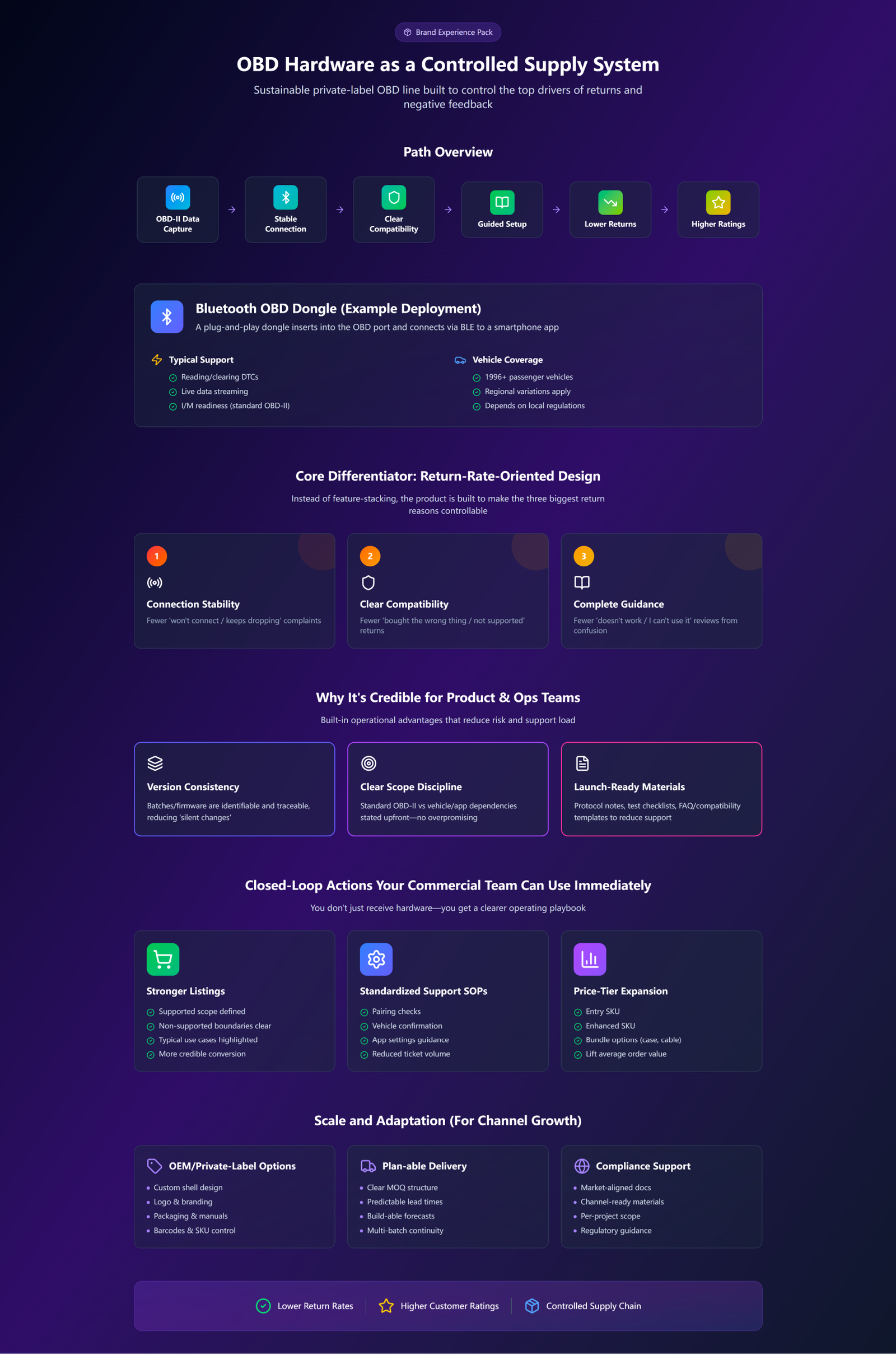
Make OBD hardware a “brand experience pack” plus a controlled supply system
A sustainable private-label OBD line is not about maximizing spec claims. It’s about controlling the top drivers of returns and negative feedback.
Path (overview)
OBD-II data capture → stable connection behavior → clear compatibility boundaries → guided setup + evidence-backed outputs → lower returns and higher ratings.
Bluetooth OBD dongle (example deployment)
A plug-and-play dongle inserts into the OBD port and connects via BLE to a smartphone app. Typical support includes: reading/clearing DTCs, live data, and I/M readiness (standard OBD-II capabilities). It generally applies to 1996+ passenger vehicles, with regional variations depending on local regulations and vehicle implementation.
Core differentiator: Return-Rate-Oriented Design
Instead of feature-stacking, the product is built to make the three biggest return reasons controllable:
• Connection stability: fewer “won’t connect / keeps dropping” complaints.
• Clear compatibility boundaries: fewer “bought the wrong thing / not supported” returns.
• Complete user guidance: fewer “doesn’t work / I can’t use it” reviews from confusion.
Why it’s credible for product and ops teams
• Version consistency: batches/firmware are identifiable and traceable, reducing “silent changes.”
• Clear scope discipline: what is standard OBD-II vs what depends on vehicle/app is stated upfront (avoids overpromising).
• Launch-ready materials: protocol notes, test checklists, and templates for FAQs/compatibility statements to reduce support load.
Closed-loop actions your commercial team can use immediately
You don’t just receive hardware—you get a clearer operating playbook:
• Stronger listings: supported scope + non-supported boundaries + typical use cases (more credible conversion).
• Standardized support SOPs: pairing checks, vehicle confirmation, app settings guidance.
• Price-tier expansion: entry / enhanced / bundle SKUs (e.g., carry case, extension cable) to lift AOV.
Scale and adaptation (for channel growth)
• OEM/private-label options: shell, logo, packaging, manuals, barcodes.
• Plan-able delivery: MOQ and lead time you can build forecasts around, with multi-batch continuity.
• Compliance support: documentation aligned to target markets/channels (provided per project scope).
TOPOLOGY
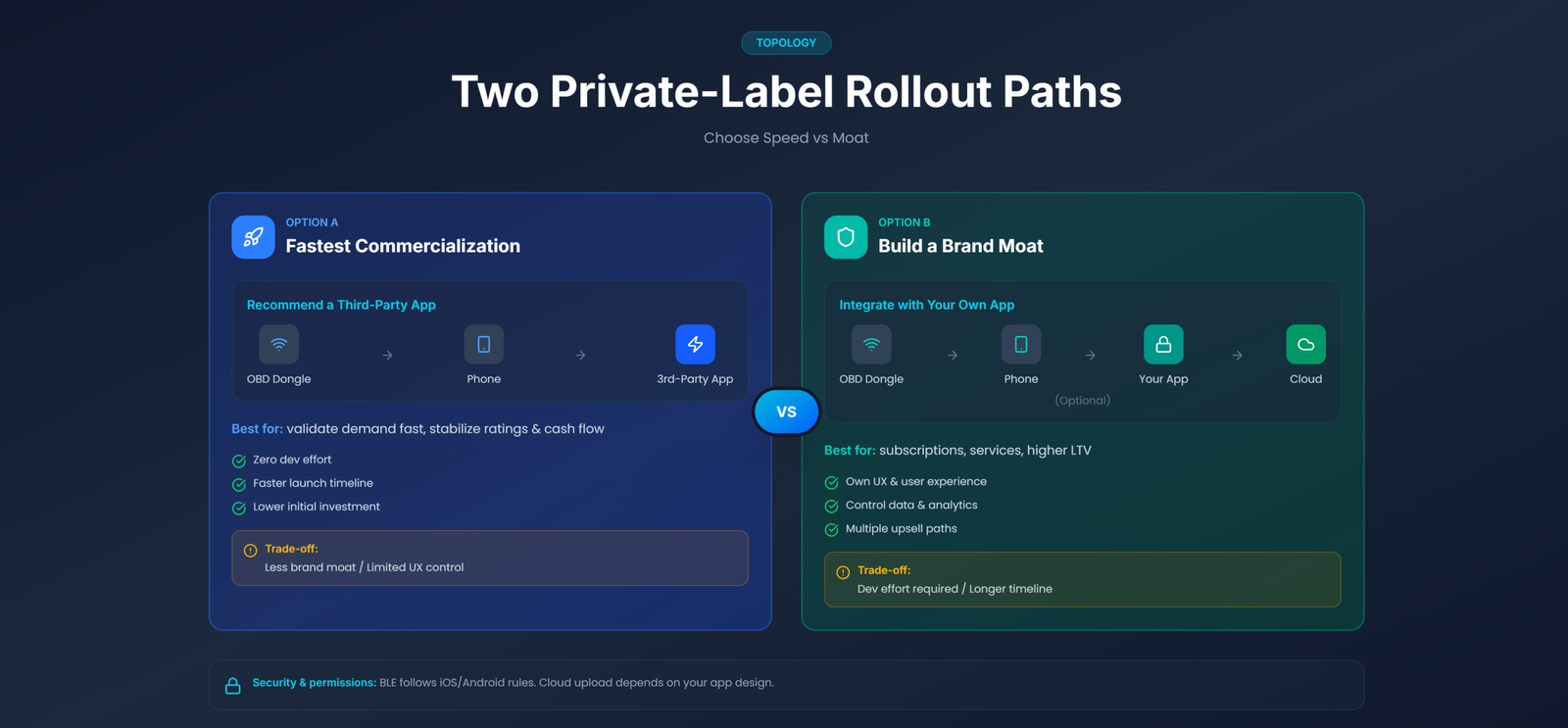
Two common rollout approaches (choose based on speed vs moat)
Option A: Recommend a third-party app (fastest commercialization)
OBD dongle → user smartphone → recommended third-party app
Best for: validating demand quickly and building rating/cash flow with minimal development.
Option B: Integrate with your own app (build a brand moat)
OBD dongle → user smartphone → your app → (optional) your cloud/membership layer
Best for: brands building subscriptions, content/services, and higher LTV.
Security & permissions: BLE access follows mobile OS permission rules; whether data is uploaded to the cloud depends on your app design.
BENEFITS
• Lower return rate → higher net margin (fewer “compatibility / connection / confusion” returns).
• Higher ratings → better conversion and more controllable ad ROI.
• Clear differentiation → less price-war pressure and more room for premium tiers.
• Faster multi-channel expansion → from marketplaces to distributors, retail, and DTC.
• Scalable SKU strategy → build compounding product-line value from entry to premium bundles.
Improvements are typically measurable within weeks via review themes, return reasons, and support ticket volume (dependent on channel and workflow).
WHY DROVE WEST?
B2B private-label focus: built for brands and channels, not one-off retail sellers.
Return-rate delivery mindset: prioritizes stability, clear boundaries, and complete materials—not spec inflation.
Integration and documentation support: sample evaluation flow, documentation pack, and templates that reduce support cost.
Controlled supply and versions: batch consistency and clear roadmap to avoid rating damage from “silent changes.”

BANNER.png "car tpms 3 安装渠道(轮胎店 维修连锁 改装店)banner - Drove West OBDII Scanner")

BANNER.png "car tpms 1 aftermarket 零售品牌 dtc 电商品牌(卖给车主)banner - Drove West OBDII Scanner")
 English