
INTRO
In insurance, clubs, connected-car services, and membership platforms, competition is increasingly a benefits war. Many programs give something away—yet users feel less and less impressed.
The moment that truly shapes trust isn’t when they receive an umbrella. It’s when a driver sees the Check Engine Light, feels uncertainty, and asks:
“Is it dangerous? Is it expensive? Can I still drive today?”
If your program can give them a simple “handle” in that moment, you change outcomes:
• fewer emotional complaints and repeated calls
• stronger “this brand is reliable” perception
• higher renewal / retention / upsell readiness
A brandable entry-level OBD code reader is one of the lowest-cost ways to turn an anxiety moment into a professional service moment.
CHALLENGE
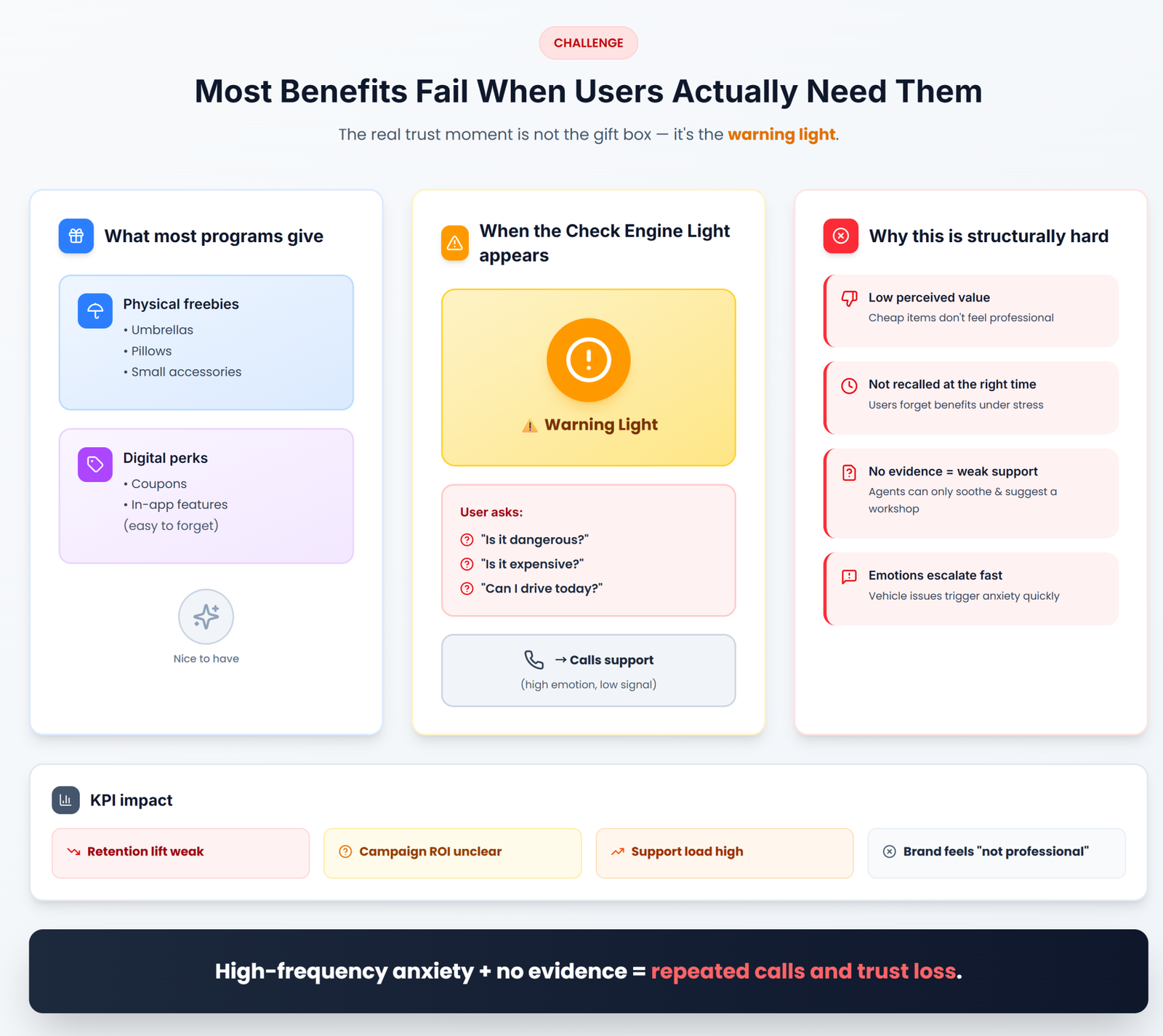
What most programs do today
Benefits often look like:
• Physical: umbrellas, pillows, aromas, small car accessories (cheap, low impact)
• Digital: in-app coupons/features (hard to remember, rarely used)
When a warning light appears, users call support. Support can only reassure and recommend a workshop—without evidence.
Why this is structurally hard
This isn’t a creativity issue—freebies fail for predictable reasons:
• Perceived value vs. cost: low-cost items rarely feel “professional.”
• Benefits aren’t recalled at the right time: users forget what they have when the problem happens.
• No evidence = weak support: without any data point, agents can only guess and soothe.
• Emotions escalate fast: vehicle issues trigger stronger anxiety than normal service questions.
KPI impact
Marketing/CRM: benefits don’t feel differentiated → weaker renewal/retention lift, lower campaign ROI.
Ops/Program: repeated initiatives with “okay” feedback → hard to justify bigger budgets.
Support: high volume of low-signal anxiety contacts → higher workload, lower satisfaction/NPS.
Brand: users feel “you’re not professional—you only sell policies/subscriptions.”
Hidden losses that compound
Check Engine Light anxiety is high-frequency—if the user drives, it will happen. A single bad experience can disproportionately damage trust, and trust directly affects renewal and referrals.
SOLUTION
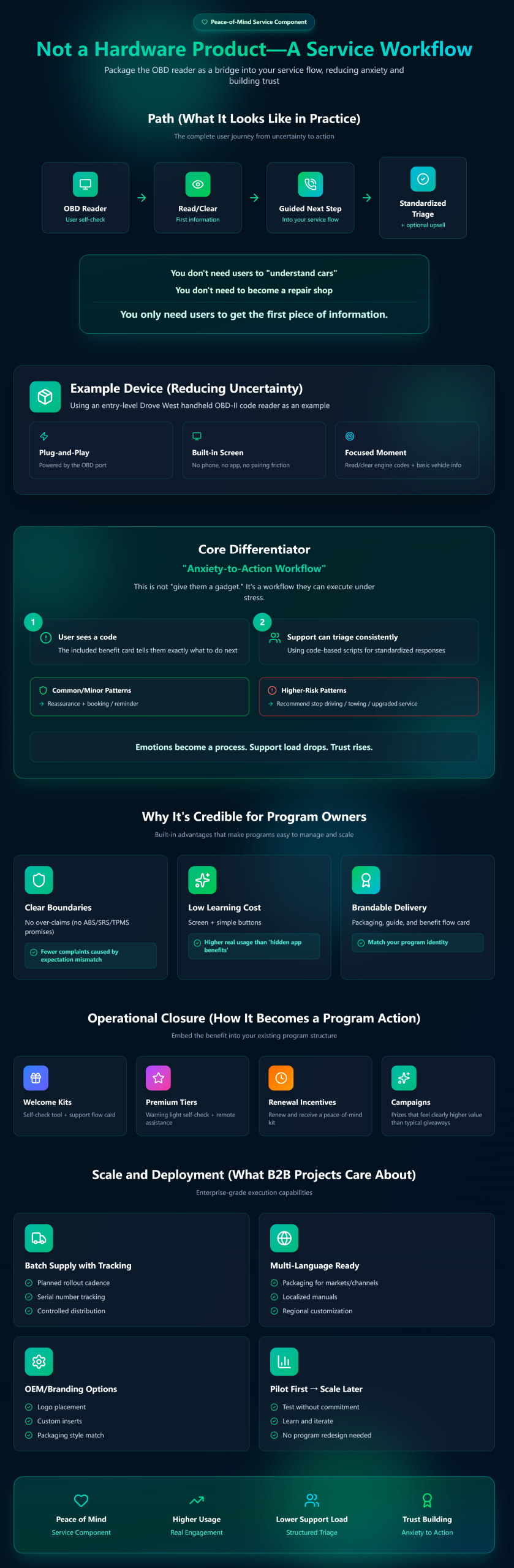
Package the OBD reader as a “peace-of-mind service component,” not a hardware product
Path (what it looks like in practice)
OBD reader → user self-check (read/clear) → guided next step into your service flow (phone / mini-program / chat) → standardized triage + optional upsell.
You don’t need users to “understand cars,” and you don’t need to become a repair shop.
You only need users to get the first piece of information.
Example device (reducing uncertainty)
Using an entry-level Drove West handheld OBD-II code reader as an example:
• Plug-and-play (powered by the OBD port)
• Built-in screen (no phone, no app, no pairing friction)
• Focused on the Check Engine Light moment: read/clear engine codes + basic vehicle info
Core differentiator: “Anxiety-to-Action Workflow”
This is not “give them a gadget.” It’s a workflow they can execute under stress:
• User sees a code → the included benefit card tells them exactly what to do next
• Support can triage consistently using code-based scripts:
– common/minor patterns → reassurance + booking / reminder
– higher-risk patterns → recommend stop driving / towing / upgraded service (based on your rules)
Emotions become a process. Support load drops. Trust rises.
Why it’s credible for program owners
• Clear boundaries: no over-claims (no ABS/SRS/TPMS promises) → fewer complaints caused by expectation mismatch.
• Low learning cost: screen + simple buttons → higher real usage than “hidden app benefits.”
• Brandable delivery: packaging, quick-start guide, and benefit flow card can match your program identity.
Operational closure (how it becomes a program action)
Embed the benefit into:
• Welcome kits: “self-check tool + support flow card”
• Premium tiers: “warning light self-check + remote assistance”
• Renewal incentives: “renew and receive a peace-of-mind kit”
• Campaigns: prizes that feel clearly higher value than typical giveaways
Scale and deployment (what B2B projects care about)
• Batch supply with tracking and planned rollout cadence
• Multi-language packaging/manuals for markets and channels
• OEM/branding options (logo, inserts, packaging style)
• Pilot first → scale later, without changing the program design
TOPOLOGY
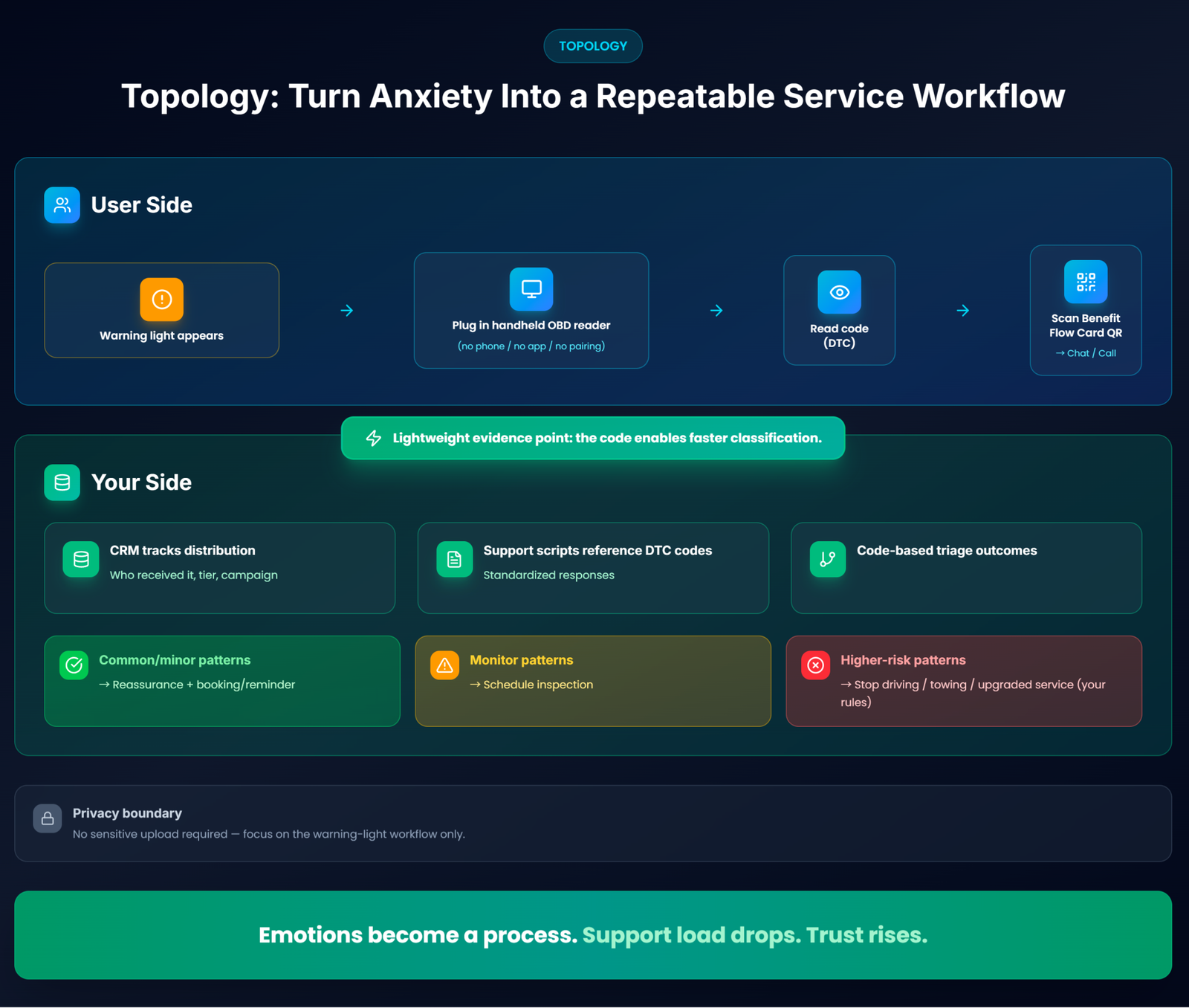
User side: handheld OBD reader + a “Benefit Flow Card” (QR to your support/chat/mini-program)
Your side: CRM tracks distribution; support scripts reference DTC codes for triage
Data: the user’s code becomes a lightweight “evidence point” to speed up classification
Privacy boundary: no need to upload sensitive data—focus on the warning-light workflow only.
BENEFITS
• Higher perceived benefit value → stronger renewal/retention/upgrade motivation
• Fewer low-signal anxiety contacts → lower support workload and fewer emotional complaints
• More professional brand perception → “you help me understand my car, not just sell a plan”
• Controlled per-user cost → differentiation without gifting expensive devices
• Reusable across programs → welcome, premium, renewal, campaign—all with one benefit component
Typical signals appear as fewer anxiety-driven tickets, higher benefit usage, and improved satisfaction feedback (timing depends on your service flow).
WHY DROVE WEST?
Built for B2B deliverability—this is a sustainable SKU, not a one-off gift batch.
Brandable by design—packaging, manuals, and benefit cards can look like your service.
Controlled scope, controlled risk—clear boundaries help prevent “gift caused new complaints.”
Pilot-friendly—validate ROI with a small rollout before expanding to the full membership base.

BANNER.png "car tpms 3 安装渠道(轮胎店 维修连锁 改装店)banner - Drove West OBDII Scanner")

BANNER.png "car tpms 1 aftermarket 零售品牌 dtc 电商品牌(卖给车主)banner - Drove West OBDII Scanner")
 English