
INTRO
For distributors and retail tool channels, diagnostics often swings between two extremes:
high-end scan tools that move slowly and require explanation, or low-cost “mystery” devices that generate returns, complaints, and brand damage.
But a large share of downstream customers only need one reliable action:
Check Engine Light is on → read the code → clear it to observe.
That’s exactly where an entry-level handheld code reader belongs—an affordable, high-turn “foundation SKU” that every catalog should include.
CHALLENGE
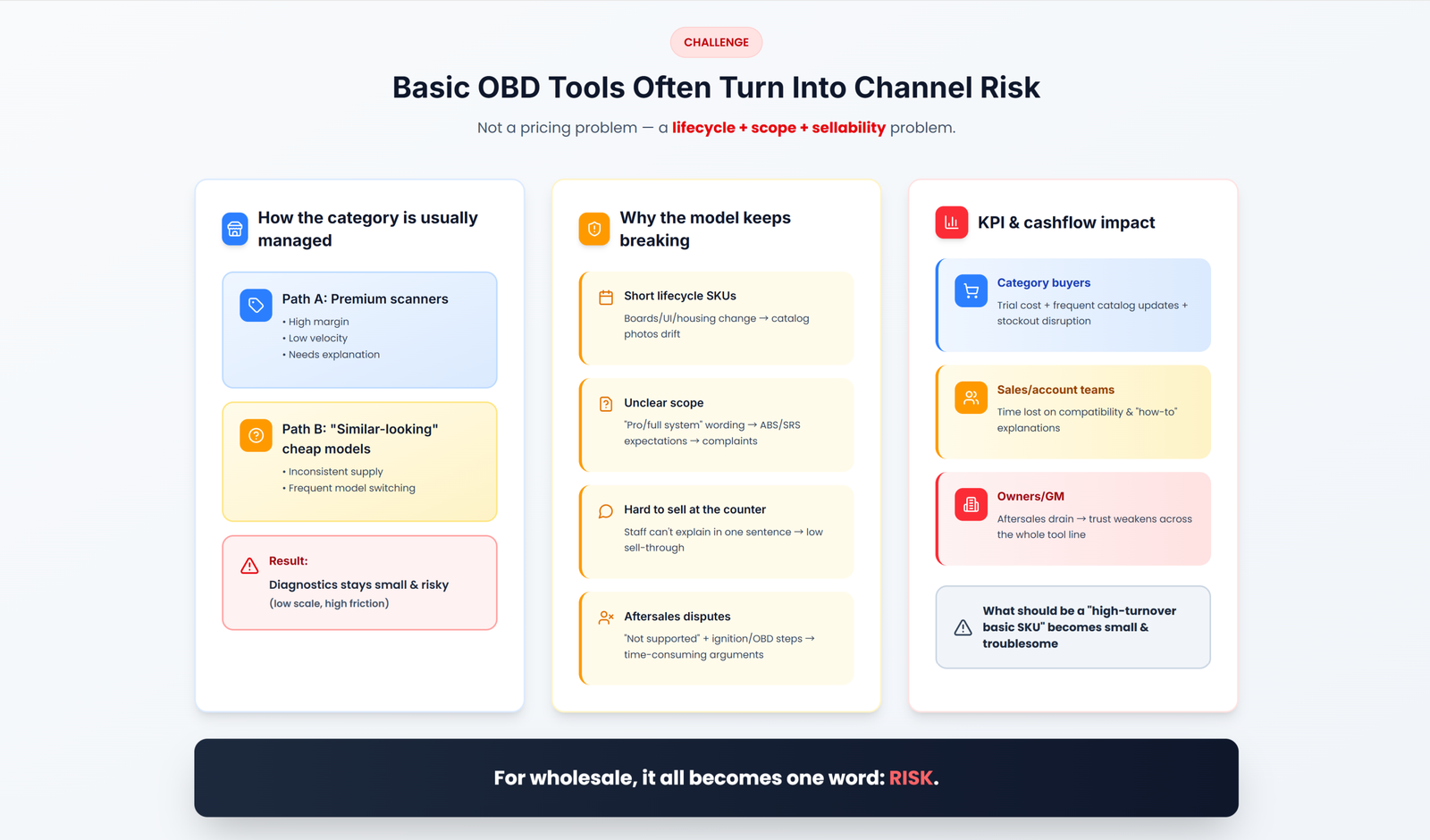
How this category is usually managed
Many distributors either:
• focus on 1–2 premium scanners (high margin, low velocity), or
• pick a “similar looking” entry-level model (inconsistent supply/versions), and
• change models frequently—making it hard for stores to remember, recommend, and reorder.
Result: diagnostics stays small and risky—low scale, high friction.
Why the model keeps breaking
Even with careful buying, predictable pitfalls show up:
• Short lifecycle SKUs: factories change boards/UI/housing—catalog photos and real products drift.
• Unclear scope: “full system/pro” wording creates ABS/SRS expectations → complaints after sale.
• Hard to sell at the counter: store staff can’t explain it in one sentence; garages default to old habits.
• Aftersales disputes: who explains “not supported,” ignition steps, or OBD port connection?
For wholesale, it all becomes one word: risk—inventory risk, brand risk, and customer-relationship risk.
KPI and cashflow impact
Category buyers: higher trial-and-error cost, frequent catalog updates, disruption from stockouts or discontinued models.
Sales/account teams: time lost on compatibility and “how-to” explanations, making the category harder to expand.
Owners/GM: a category that should add professionalism becomes an aftersales drain that weakens trust across the tool line.
SOLUTION
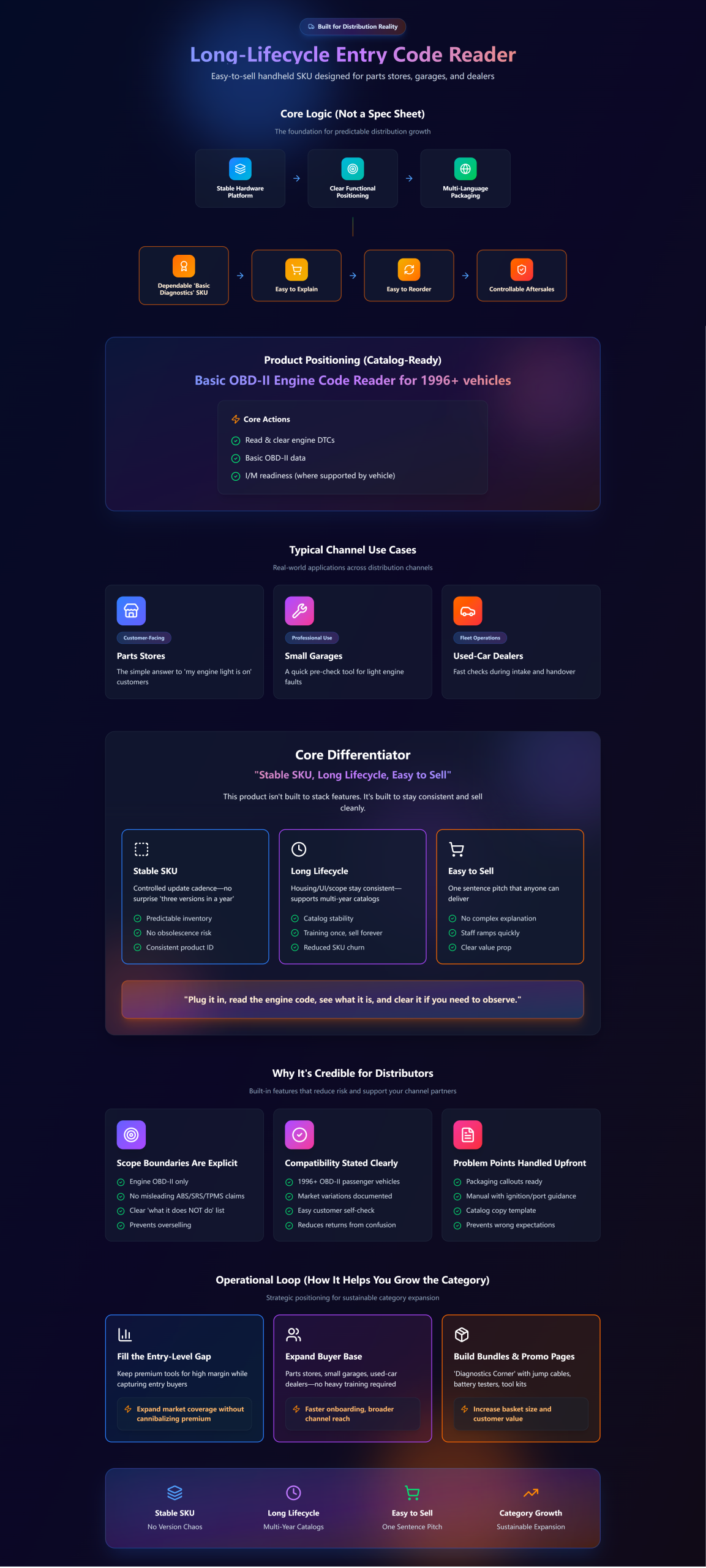
A long-lifecycle, easy-to-sell entry handheld code reader—built for distribution reality
Path (core logic, not a spec sheet)
Stable hardware platform + clear functional positioning + multi-language packaging/manual →
a dependable “Basic Diagnostics” SKU →
easy to explain, easy to reorder, and controllable aftersales.
Product positioning (catalog-ready, one line)
Basic OBD-II Engine Code Reader for 1996+ vehicles
Core actions: read & clear engine DTCs, basic OBD-II data (and I/M readiness where supported by vehicle).
Typical channel use cases
• Parts stores: the simple answer to “my engine light is on” customers.
• Small garages: a quick pre-check tool for light engine faults.
• Used-car dealers: fast checks during intake and handover.
Core differentiator: “Stable SKU, Long Lifecycle, Easy to Sell”
This product isn’t built to stack features. It’s built to stay consistent and sell cleanly:
• Stable SKU: controlled update cadence—no surprise “three versions in a year.”
• Long lifecycle: housing/UI/scope stay consistent—supports multi-year catalogs.
• Easy to sell: one sentence pitch:
“Plug it in, read the engine code, see what it is, and clear it if you need to observe.”
Why it’s credible for distributors
• Scope boundaries are explicit: engine OBD-II only; no misleading ABS/SRS/TPMS claims.
• Compatibility is stated clearly: 1996+ OBD-II passenger vehicles (market variations can be documented).
• “Problem points” are handled upfront in materials you can reuse:
packaging callouts, manual with ignition/OBD-port guidance, and catalog copy that prevents wrong expectations.
Operational loop (how it helps you grow the category)
• Fill the entry-level gap while keeping premium tools for high margin.
• Expand buyer base (parts stores, small garages, used-car dealers) without heavy training.
• Build bundles and promo pages (“Diagnostics Corner”) with jump cables, battery testers, and tool kits.
TOPOLOGY
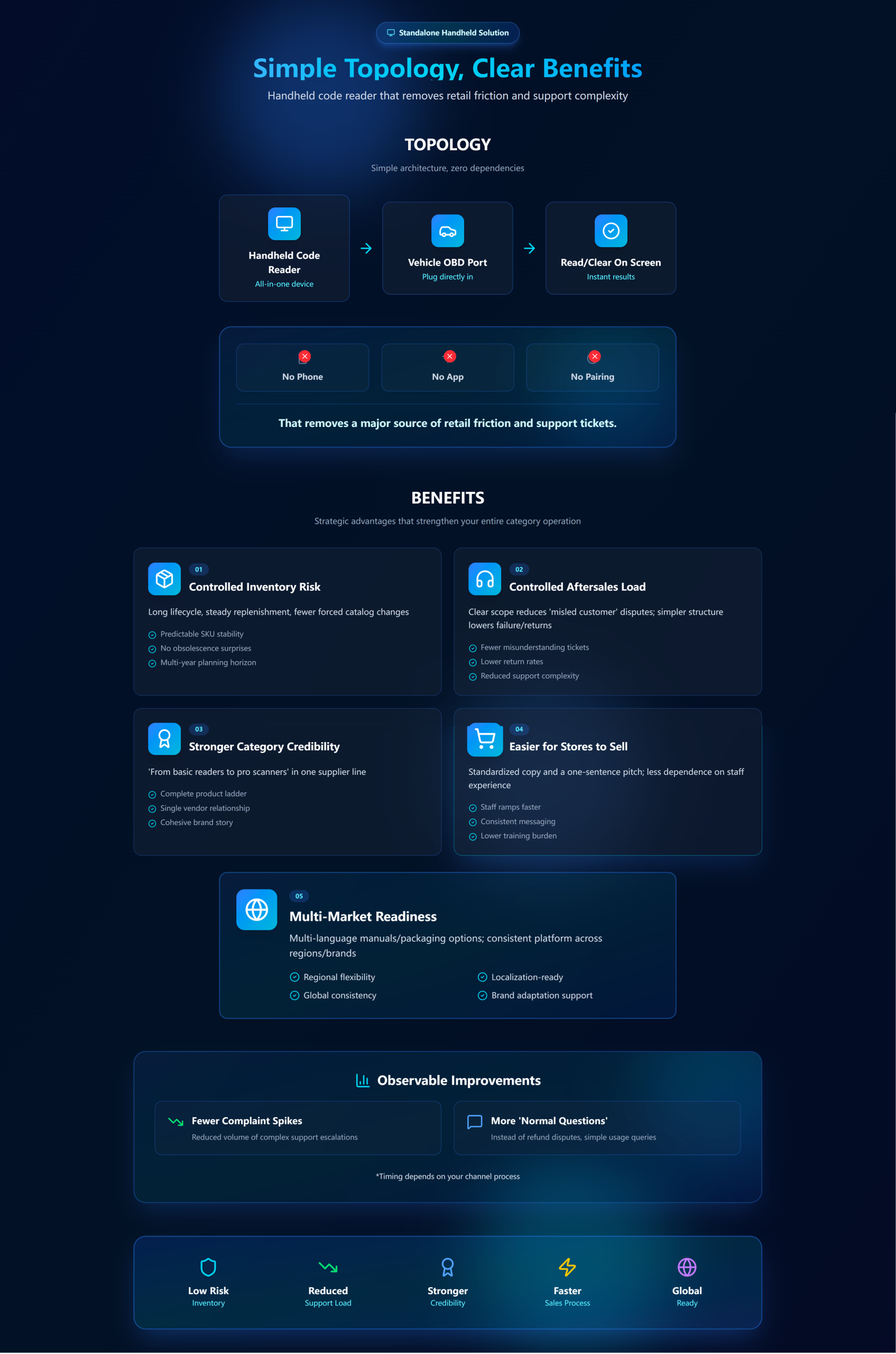
Handheld code reader → plugs into vehicle OBD port → reads/clears on screen
No phone. No app. No pairing.
That removes a major source of retail friction and support tickets.
BENEFITS
• Controlled inventory risk: long lifecycle, steady replenishment, fewer forced catalog changes.
• Controlled aftersales load: clear scope reduces “misled customer” disputes; simpler structure lowers failure/returns.
• Stronger category credibility: “from basic readers to pro scanners” in one supplier line.
• Easier for stores to sell: standardized copy and a one-sentence pitch; less dependence on staff experience.
• Multi-market readiness: multi-language manuals/packaging options; consistent platform across regions/brands.
Improvements typically show up as fewer complaint spikes and more “normal questions” instead of refund disputes (timing depends on your channel process).
WHY DROVE WEST?
We work in a distributor mindset: build a foundation SKU that sells, doesn’t cause drama, and can stay in your catalog for years.
• Long-term SKU strategy: controlled change management and planned replacement path (EOL planning).
• OEM & multi-market support: housing color, button language, screen language, packaging and manuals tailored to your markets.
• Channel-friendly materials: catalog copy templates, counter pitch points, and FAQ/Q&A to help downstream stores sell with confidence.

BANNER.png "car tpms 3 安装渠道(轮胎店 维修连锁 改装店)banner - Drove West OBDII Scanner")

BANNER.png "car tpms 1 aftermarket 零售品牌 dtc 电商品牌(卖给车主)banner - Drove West OBDII Scanner")
 English