
INTRO
TPMS is a high-demand safety category—but in retail channels it often becomes a margin-leak category. A return costs more than a lost sale: it adds labor, logistics, inspection, and repeated explanations across stores.
What distributors actually need is not “maximum features.” They need a program that is:
- easy to sell (three-sentence pitch)
- hard to misunderstand (clear boundaries)
- stable across batches (catalog + shelf assets don’t break)
- replenishable (fill rate stays high in peak season)
That’s the logic behind a two-SKU lineup built specifically for shelf performance.
CHALLENGE

Common retail reality
- Buyers trial too many SKUs by price point.
- Stores sell based on staff confidence, not technical fit.
- Support becomes reactive: pairing issues, battery questions, “jumping readings,” water/dirt exposure, durability claims.
Root causes (not a “team problem”)
TPMS return risk is driven by predictable variability:
- Pairing and reconnection complexity across phone models, permissions, and OS behavior.
- Expectation mismatch: “works on every car,” “no phone needed,” “always stable,” “no learning/calibration required.”
- Harsh environments: temperature swings, rain/dust, highway vibration.
- SKU/version churn invalidates shelf talkers, manuals, and staff training.
The business impact (mapped to KPIs)
- Purchasing/Category: return rate rises → gross margin erodes; inventory turns slow.
- Sales/Channel: stores stop recommending → sell-through drops; promos underperform.
- Returns/Quality: RMA tickets + inspection + “who explains it?” time spikes.
Hidden loss
- Peak-season stockouts or slow replenishment → chains switch suppliers quickly.
- Batch inconsistency → printed assets become obsolete.
- Channel conflict (supplier undercutting) → distributor programs end immediately.
SOLUTION
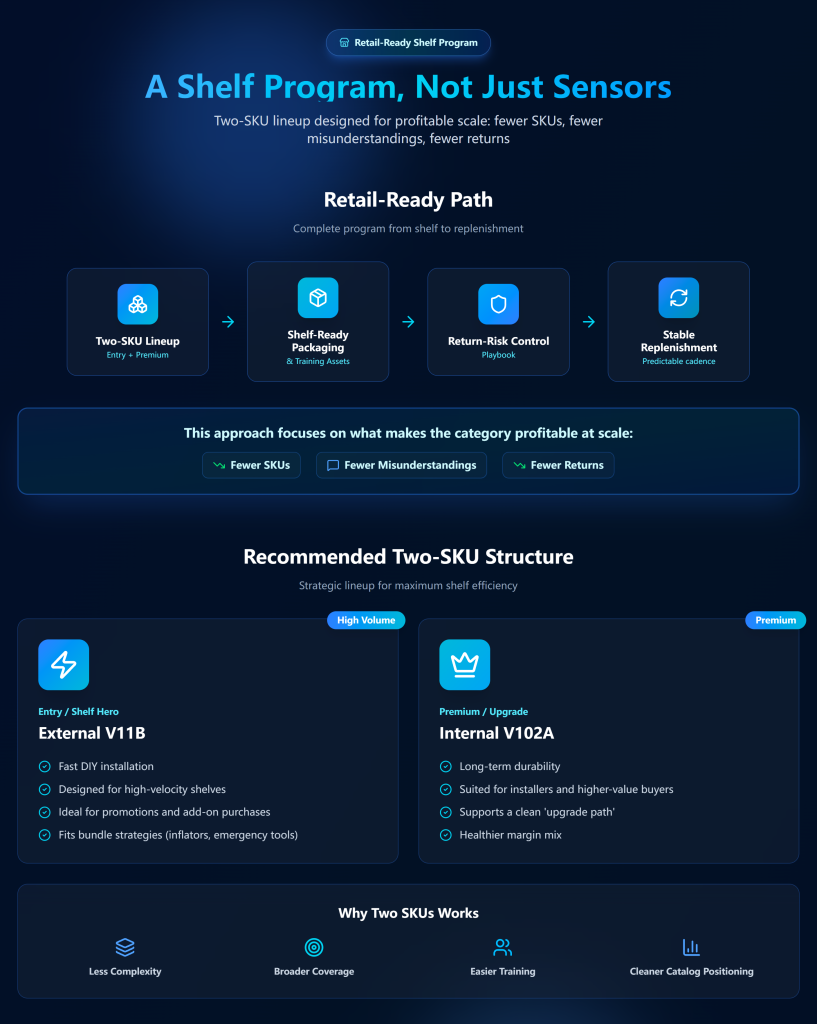
Solution: a shelf program, not just sensors
Retail-ready path
Two-SKU lineup → shelf-ready packaging & training assets → return-risk control playbook → stable replenishment
This approach focuses on what makes the category profitable at scale: fewer SKUs, fewer misunderstandings, fewer returns.
Recommended two-SKU structure
Entry / Shelf Hero: External V11B
- fast DIY installation, designed for high-velocity shelves
- ideal for promotions and add-on purchases
- fits bundle strategies (inflators, emergency tools)
Premium / Upgrade: Internal V102A
- long-term durability, suited for installers and higher-value buyers
- supports a clean “upgrade path” and healthier margin mix
Why two SKUs works: less complexity, broader coverage, easier training, cleaner catalog positioning.
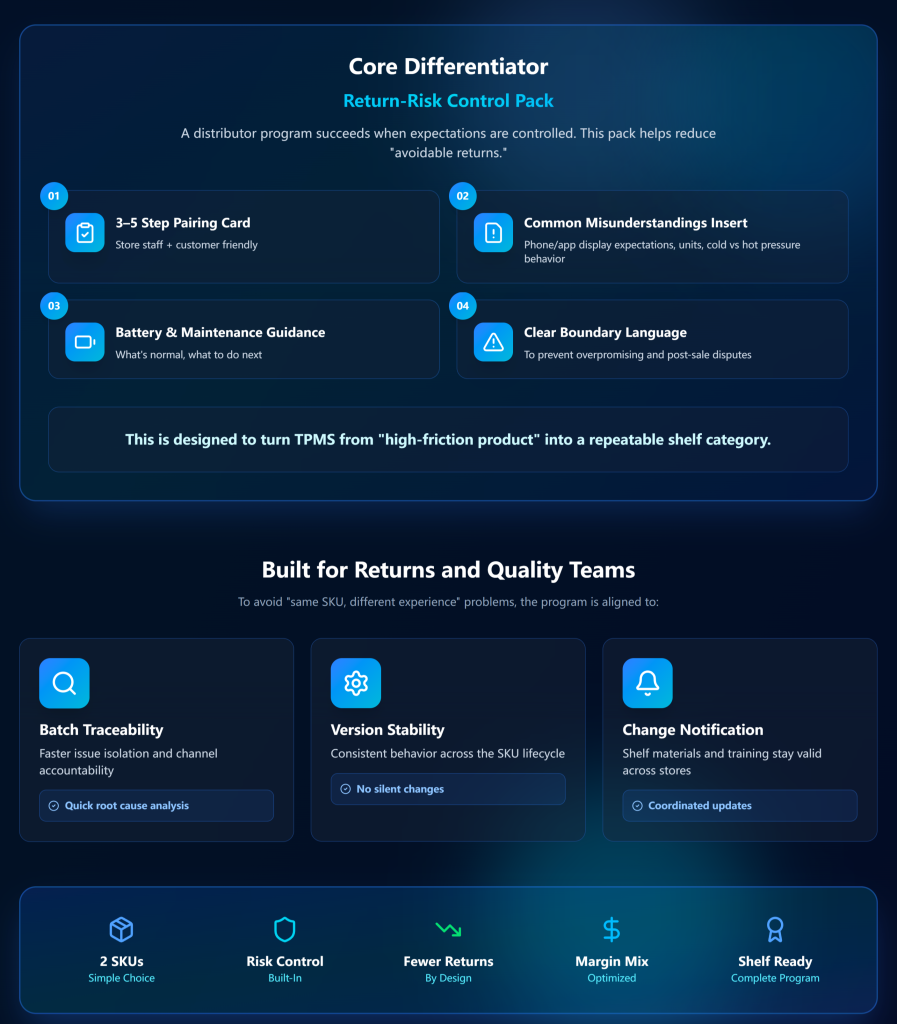
Core differentiator: Return-Risk Control Pack
A distributor program succeeds when expectations are controlled. Alongside the SKUs, the delivery includes a Return-Risk Control Pack that helps reduce “avoidable returns”:
- 3–5 step pairing card (store staff + customer friendly)
- Common misunderstandings insert (phone/app display expectations, units, cold vs hot pressure behavior)
- Battery & maintenance guidance (what’s normal, what to do next)
- Clear boundary language to prevent overpromising and post-sale disputes
This is designed to turn TPMS from “high-friction product” into a repeatable shelf category.
Built for returns and quality teams
To avoid “same SKU, different experience” problems, the program is aligned to:
- Batch traceability: faster issue isolation and channel accountability
- Version stability: consistent behavior across the SKU lifecycle
Change notification: shelf materials and training stay valid across stores
TOPOLOGY

- Products: External / Internal TPMS sensors
- Customer display/verification: an app can be used as a user-side verification tool (not the selling foundation)
- Channel delivery: packaging, manuals, shelf cards, FAQ, batch tracking
Key point: staff don’t need BLE knowledge—only a clear install + expectation script.
Benefits (decision-ready)
- Higher sell-through: two SKUs cover entry + upgrade customers
- Lower return rate: fewer pairing/expectation-driven returns
- Lower RMA cost: traceability + triage assets reduce back-and-forth
- Better fill rate: predictable lead time supports peak replenishment
Easier replication: consistent materials reduce store training cost
(Impact is typically visible during a pilot via return reasons and ticket volume.)
WHY DROVE WEST?
- Channel-oriented delivery: retail-ready packaging, multi-language materials, barcode/label options
- Supply + version stability mindset: designed for catalog lifecycles and chain replenishment
- OEM/white-label readiness: packaging, language, and channel story aligned to your market plan
Channel-friendly programs where applicable: structured distributor rollouts with clear boundaries

BANNER.png "car tpms 3 安装渠道(轮胎店 维修连锁 改装店)banner - Drove West OBDII Scanner")
BANNER.png "car tpms 1 aftermarket 零售品牌 dtc 电商品牌(卖给车主)banner - Drove West OBDII Scanner")

 English