
INTRO
TPMS is one of those aftermarket categories that looks “easy to sell” online—until it hits real users. In practice, the biggest losses are rarely caused by sensor specs on paper. They come from operational reality:
- unstable connection experiences
- “jumping” readings that users interpret as faulty products
- misunderstanding of install/learning/calibration expectations
- silent batch or protocol changes that break app-side behavior
These issues show up directly in review score, return rate, ticket volume, and ultimately conversion, ad ROI, ranking and cash flow—especially during peak season.
At the same time, many brands don’t want the core experience living inside a supplier’s app. If you’re building a real aftermarket brand, the app should be your asset: users, data, UX and iteration pace controlled by you.
That’s why this use case focuses on a simple split:
You run product + growth in your app. We deliver integration-ready BLE TPMS hardware, a deliverable documentation kit and stable supply.
CHALLENGE
-1-scaled-e1769851005269.png "car tpms 1 aftermarket 零售品牌 dtc 电商品牌(卖给车主) 1 - Drove West OBDII Scanner")
The most common TPMS launch patterns usually look like this:
- Generic TPMS + supplier demo app “just to get to market”
- List first, fix later and rely on support to educate users
- Firefighting after launch: pairing guides, false alert explanations, RMAs and replacements
However, TPMS support risk is structurally high because the uncertainty is structural:
- Complex BLE chain: iOS/Android differences, permission flows, background limits, reconnection strategies
- Variable environment: temperature changes, metal shielding, tire conditions, parking vs driving states
- Expectation mismatch: users assume “install once = always stable” and “all vehicles behave the same”
- Batch/version risk: small untracked changes can break parsing, binding logic, or UI expectations
Operational impact
- Marketplace: negative reviews → lower conversion → weaker ad efficiency → ranking drop
- Support: tickets spike (pairing / drops / false alerts / battery) → higher cost and slower response
- Finance: returns + RMA eat margin → cash flow volatility, worst during peak demand
Hidden loss
Reviews are lagging but amplified: one wave of complaints can hurt traffic and ROI for weeks/months. And if the app experience is not controllable, TPMS becomes a commodity listing.
SOLUTION
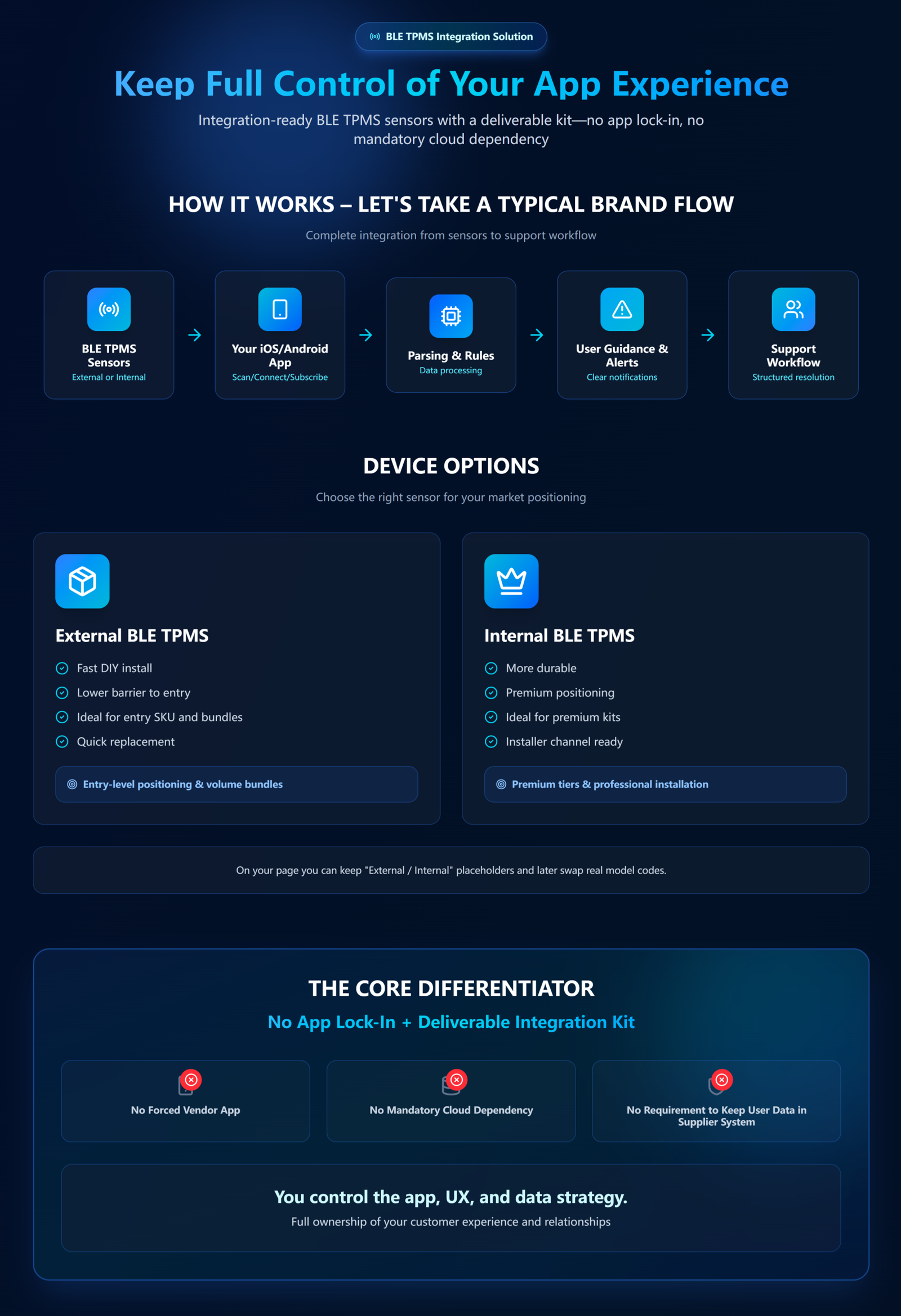
To address these challenges, Drove West provides integration-ready BLE TPMS sensors (external and internal) together with a deliverable integration kit—so the brand keeps full control of the app experience.
HOW IT WORKS – LET’S TAKE A TYPICAL BRAND FLOW
BLE TPMS sensors → Your iOS/Android app (scan/connect/subscribe) → parsing & rules → user guidance & alerts → support workflow
DEVICE OPTIONS
- External BLE TPMS: fast DIY install, ideal for entry SKU and bundles
- Internal BLE TPMS: more durable, ideal for premium kits and installer channels
THE CORE DIFFERENTIATOR
No App Lock-In + Deliverable Integration Kit
- No forced vendor app
- No mandatory cloud dependency
- No requirement to keep user data in a supplier system
You control the app, UX, and data strategy.
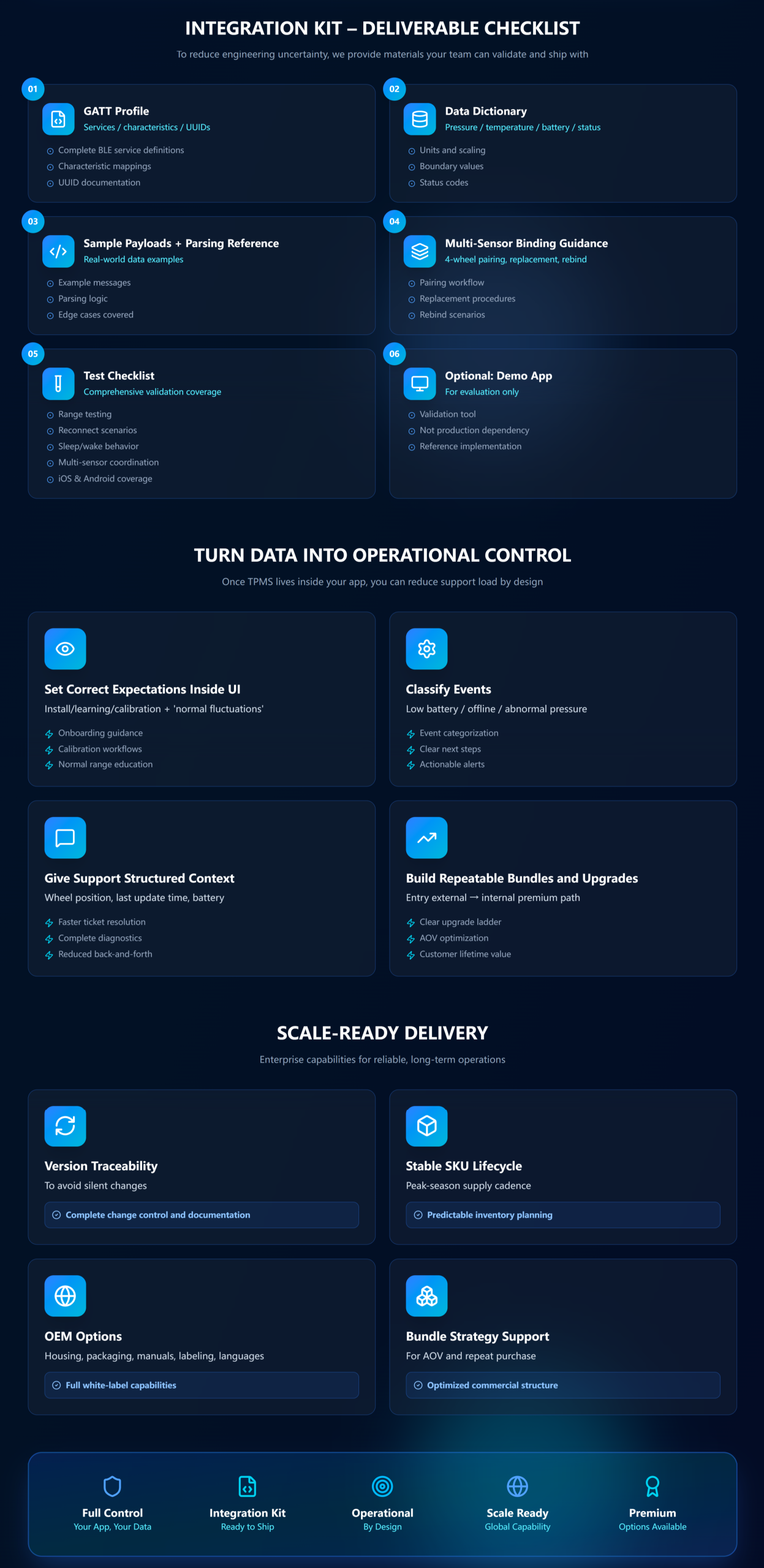
INTEGRATION KIT – DELIVERABLE CHECKLIST
To reduce engineering uncertainty, we provide integration-ready reference materials your team can validate and ship with:
- BLE Manufacturer Data advertising payload specification
(field layout, byte length, and example broadcast payload) - Data dictionary & scaling rules
(pressure, temperature, battery level, leak status — units, calculation methods, and boundary values) - Example payload decoding & parsing reference
(how to extract pressure, temperature, battery, and status from broadcast data) - Multi-sensor binding & wheel-position mapping guidance
(4-wheel pairing logic based on BLE address prefix and device ID, including replacement and rebind scenarios) - Broadcast behavior & control logic reference
(stationary vs moving intervals, configurable parameters, and fast-leak trigger behavior) - iOS background scanning note
(UUID-based filtering for capturing TPMS broadcast data in background)
TURN DATA INTO OPERATIONAL CONTROL
Once TPMS lives inside your app, you can reduce support load by design:
- Set correct expectations inside UI (install/learning/calibration + “normal fluctuations”)
- Classify events (low battery / offline / abnormal pressure) and provide clear next steps
- Give support structured context (wheel position, last update time, battery) to close tickets faster
- Build repeatable bundles and upgrades (entry external → internal premium path)
SCALE-READY DELIVERY
- Version traceability to avoid silent changes
- Stable SKU lifecycle and peak-season supply cadence
- OEM options: housing, packaging, manuals, labeling, languages
- Bundle strategy support for AOV and repeat purchase
TOPOLOGY
-2-scaled-e1769852285225-1024x885.png "car tpms 1 aftermarket 零售品牌 dtc 电商品牌(卖给车主) 2 - Drove West OBDII Scanner")
Device: External/Internal BLE TPMS sensors
Communication: BLE → iOS/Android
Your app: scan/connect/subscribe/parse → UI/alerts/guidance
Optional backend: device binding, support records, membership logic
Privacy boundary: data flows through your app; no forced upload to supplier systems.
BENEFITS
- Lower returns and review risk → more stable listings and better ROI
- App + data control → brand asset, not a generic commodity
- Faster integration → docs, samples and checklist reduce engineering uncertainty
- Clear SKU ladder + bundles → higher AOV and repeat purchase potential
Peak-season stability → stable versions + stable supply protect your ad spend
WHY DROVE WEST?
Drove West is built for B2B/OEM delivery—not for selling consumer apps.
- Integration-first support with deliverable documentation and test flow
- Version stability mindset to protect your app and listings
- OEM + multi-market readiness for US/EU/AU aftermarket cycles
- Scalable supply planning for pilot → launch → peak season

BANNER.png "car tpms 3 安装渠道(轮胎店 维修连锁 改装店)banner - Drove West OBDII Scanner")


 English